Territory Is Not Neutral: It is an Agent of Social Dynamics

Ana Luisa Maffini
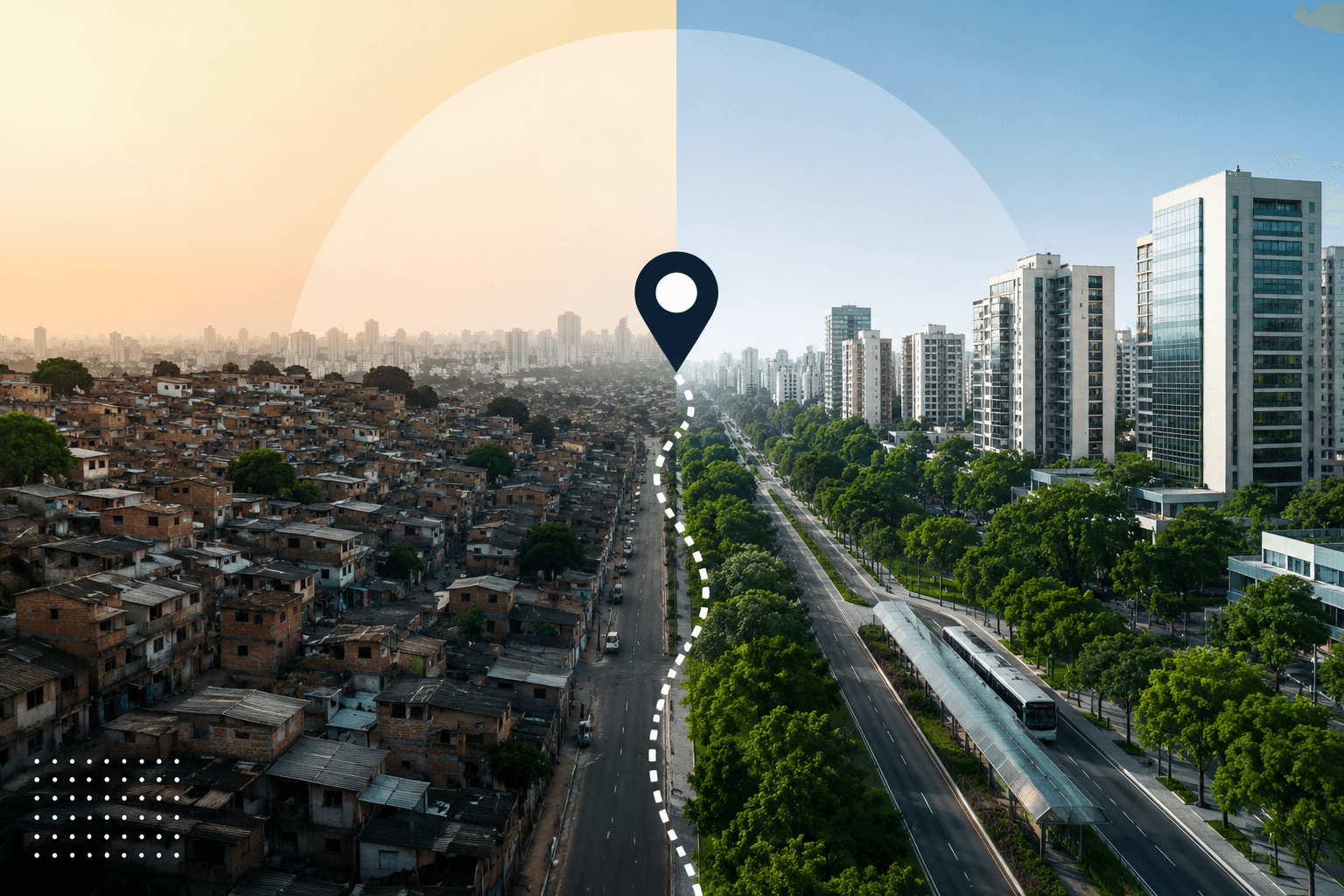
When we think about cities, it is common to imagine territory merely as the setting where life takes place. People work, study, travel, consume, and interact, while streets, neighborhoods, and buildings seem to play only the role of a backdrop for these activities. From this perspective, territory appears to be a passive element, an empty space that simply accommodates social actions.
However, this view greatly oversimplifies urban reality. Research in Urban Studies, Geography, Sociology, and Urban Planning has consistently shown that the territory is not neutral. It does not simply host human activities; it also influences how they occur, shaping opportunities, constraining choices, and affecting the social dynamics we observe every day.
In other words, the territory is not merely the stage on which society performs. It is also part of the performance itself.
Beyond Physical Space
When we speak of territory, we are referring to much more than physical land or the surface occupied by cities. Territory encompasses the spatial organization of activities, infrastructure, services, transportation networks, and social relations.
The location of housing, the distance to workplaces, the presence of schools, hospitals, green spaces, or cultural facilities are not randomly distributed across urban space. These conditions vary from place to place and have tangible effects on people's lives.
Two families with similar incomes may experience very different realities depending on the neighborhood in which they live. One may have easy access to jobs, efficient public transportation, and public services. The other may face long daily commutes, limited access to urban amenities, and higher mobility costs.
Although their socioeconomic characteristics may be similar, territory creates different conditions for accessing urban opportunities.
Space Shapes Opportunities
One of the most visible ways in which territory influences society is through access to opportunities.
Jobs, services, commerce, education, and healthcare are not evenly distributed throughout cities. Certain areas tend to concentrate a greater diversity of activities, while others offer limited access to urban resources.
As a result, where a person lives directly affects their ability to reach these opportunities. The greater the distance, cost, or difficulty involved in accessing them, the fewer opportunities are likely to be available.
For this reason, access to opportunities depends not only on individual characteristics but also on the spatial characteristics of the places where people live.
In this context, territory can act either as a facilitator or as a barrier.
Urban Form Matters
The influence of territory goes beyond the location of urban elements. The spatial configuration of cities also plays a crucial role.
Not all streets have the same capacity to connect people, activities, and places. Some function as major movement corridors, concentrating flows of people, economic activities, and social interactions. Others remain relatively isolated within the urban structure.
These differences are closely related to how the urban network is organized.
Well-connected neighborhoods tend to have higher accessibility and greater potential to attract economic activities. Conversely, fragmented or segregated areas may struggle to integrate with the rest of the city, even when they are geographically close to urban centers.
Spatial configuration therefore influences not only mobility but also the location of activities, property values, pedestrian movement, and the intensity of social interactions.
Territory and the Production of Inequality
Urban inequalities are often examined from economic and social perspectives. However, they also have a spatial dimension.
The uneven distribution of infrastructure, services, and opportunities creates different living conditions within the same city. In many cases, socially vulnerable groups become concentrated in areas characterized by lower accessibility, fewer services, or greater exposure to environmental hazards.
This process causes social and spatial inequalities to reinforce one another.
Location influences access to opportunities. Access to opportunities affects living conditions. Living conditions, in turn, influence people's ability to choose where they live and work.
As a result, territory does not merely reflect existing inequalities. It also participates in their reproduction over time.
Territory Also Distributes Risks
Just as opportunities are unevenly distributed, so are risks.
Flood-prone areas, unstable slopes, neighborhoods with limited vegetation cover, urban heat islands, and places exposed to pollution are not evenly spread across cities.
Exposure to these risks depends heavily on location and territorial characteristics.
The floods that affected numerous cities in southern Brazil in 2024 illustrated this relationship clearly. Although the climatic event impacted large regions, its consequences varied significantly across municipalities, neighborhoods, and social groups. Factors such as location, infrastructure, vegetation cover, and urban conditions directly influenced levels of vulnerability.
Once again, territory demonstrated that it is far from neutral.
A Product of History and Collective Decisions
It is important to recognize that territory does not emerge spontaneously. The spatial structure of cities results from historical processes accumulated over decades, or even centuries.
Public investments, infrastructure development, real estate expansion, housing policies, urban regulations, and economic decisions all contribute to shaping the urban environments we see today.
The opportunities and inequalities embedded within territory are, to a large extent, the result of these accumulated choices.
Understanding cities therefore requires looking not only at people and activities but also at the spatial processes that have organized these relationships over time.
Understanding Territory to Understand Cities
The idea that territory is not neutral represents a significant shift in how we interpret urban phenomena.
Rather than viewing space as a passive container in which society unfolds, we begin to recognize it as an active component of social dynamics. Territory influences mobility, opportunities, interactions, risks, and inequalities. It shapes part of the range of possibilities available to individuals, groups, and institutions.
This does not mean that space completely determines human behavior. People continue to make choices, develop strategies, and transform the places where they live. However, these choices always occur within a set of spatial conditions that make some possibilities easier and others more difficult.
For this reason, understanding cities necessarily requires understanding their territories.
After all, social dynamics do not occur on neutral ground. They unfold within a territory that actively participates in their construction.