My most recent work
Research, Tools and Educational Resources for Understanding Cities
My work combines urban research, spatial analysis, geospatial technologies and education to investigate how cities function, how inequalities emerge in space and how data can support better urban understanding and planning.
Through research projects, open-source tools, educational materials and methodological developments, I seek to bridge urban theory, spatial thinking and data-driven approaches to cities.
Featured Projects
Spatial Inequalities and Urban Segregation
My research investigates how spatial configuration influences urban inequalities, accessibility and socio-spatial segregation.
By combining street network analysis, configurational approaches and socio-economic indicators, I explore how urban structures shape access to opportunities, services and social interaction.
Research Topics
Urban segregation;
Accessibility inequalities;
Spatial configuration;
Urban morphology;
Metropolitan dynamics.
Methods
Spatial Analysis, Network Science, GIS, Urban Morphology, Statistical Analysis.


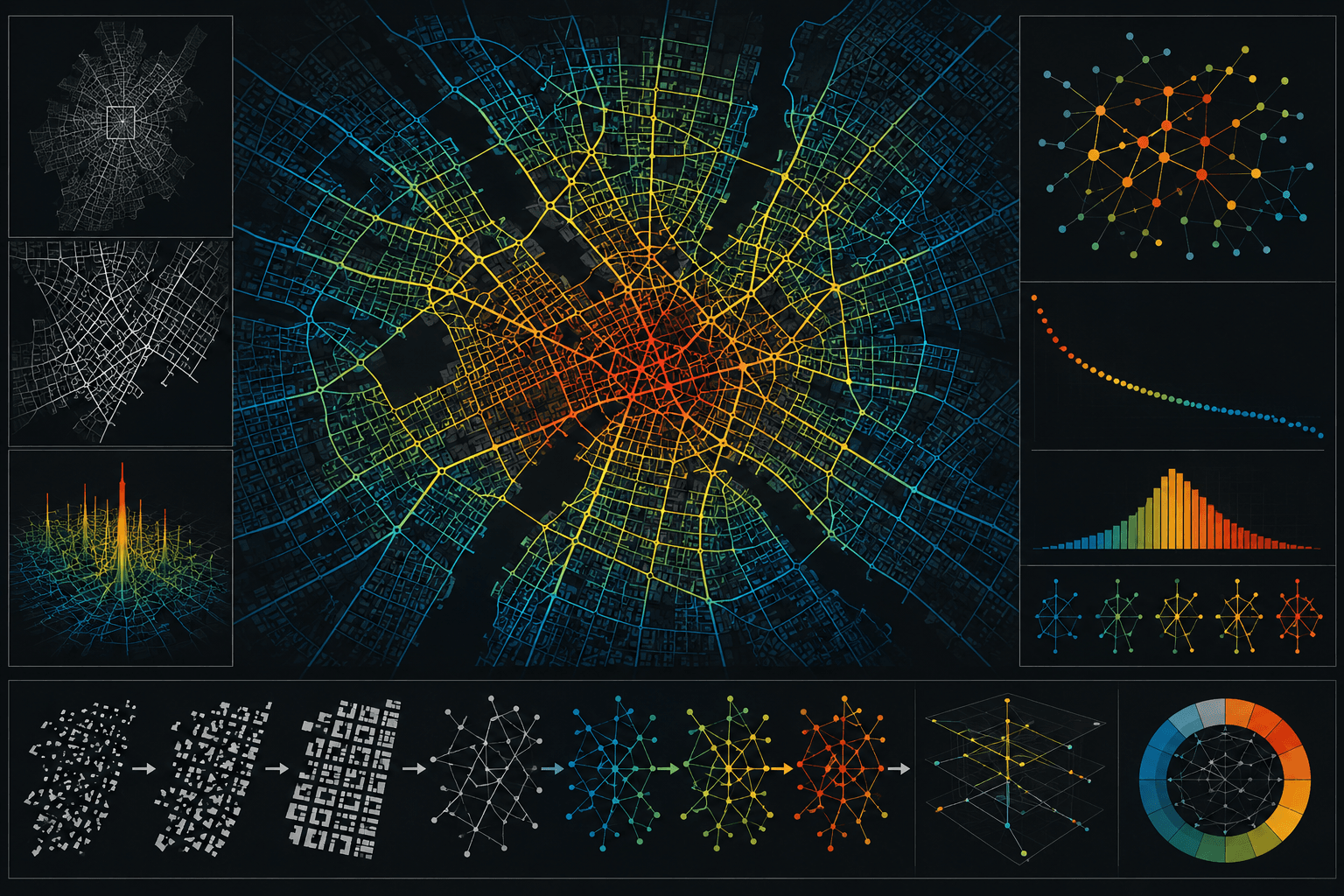
Urban Networks and Accessibility
Accessibility is one of the central themes of my research.
Through the analysis of street networks and spatial relationships, I investigate how urban form influences movement, connectivity and opportunities within cities.
This work includes the development of indicators, accessibility measures and network-based approaches applied to Brazilian cities and metropolitan regions.
Methods
Network Analysis, Centrality Measures, Accessibility Metrics, GIS.

Green Infrastructure and Urban Resilience
This line of work explores the relationships between urban vegetation, landscape structure and environmental resilience.
Using landscape metrics, spatial statistics and geospatial analysis, I investigate how urban green infrastructure contributes to climate adaptation and flood resilience.
Research Topics
Urban vegetation;
Landscape fragmentation;
Environmental resilience;
Flood-related impacts;
Nature-based solutions.
Methods
Landscape Metrics, Spatial Statistics, PCA, LISA, GIS.

I strongly believe that urban research should be transparent, reproducible and accessible.
For this reason, I actively develop open workflows, scripts, datasets and methodological documentation that allow other researchers and practitioners to replicate, adapt and expand analytical processes.
My work frequently incorporates:
OpenStreetMap;
Overture Maps;
Brazilian Census data;
CNEFE datasets;
Open-source GIS tools;
Reproducible Python workflows.

Teaching and knowledge dissemination are fundamental aspects of my work.
I develop educational materials, tutorials and workshops focused on spatial analysis, GIS, urban data science and computational methods for urban research.
These resources are designed to help students, researchers and professionals understand and apply spatial methods in their own projects.
Topics Include
QGIS and GIS Fundamentals;
Spatial Analysis;
Urban Network Analysis;
Open Urban Data;
Python for GIS;
Urban Data Science;
Artificial Intelligence for Academic Research.

Methods and Technical Expertise
My work is grounded in the integration of urban theory and computational methods.
Areas of Expertise
Geographic Information Systems (GIS);
Spatial Analysis;
Urban Morphology;
Network Science;
Accessibility Analysis;
Urban Data Science;
Geocomputation;
Spatial Statistics;
Open Urban Data;
Spatial Databases;
Python and SQL for Urban Analytics.

Current Focus
My current research focuses on urban inequalities, spatial configuration and accessibility in metropolitan regions, with particular attention to vulnerable territories and the role of urban networks in shaping opportunities and everyday urban experiences.
Through research, software development and educational initiatives, I aim to contribute to a deeper understanding of cities and to the development of more equitable, resilient and evidence-informed urban futures.