Why Geospatial Data Matter: Understanding the World Through Location

Ana Luisa Maffini
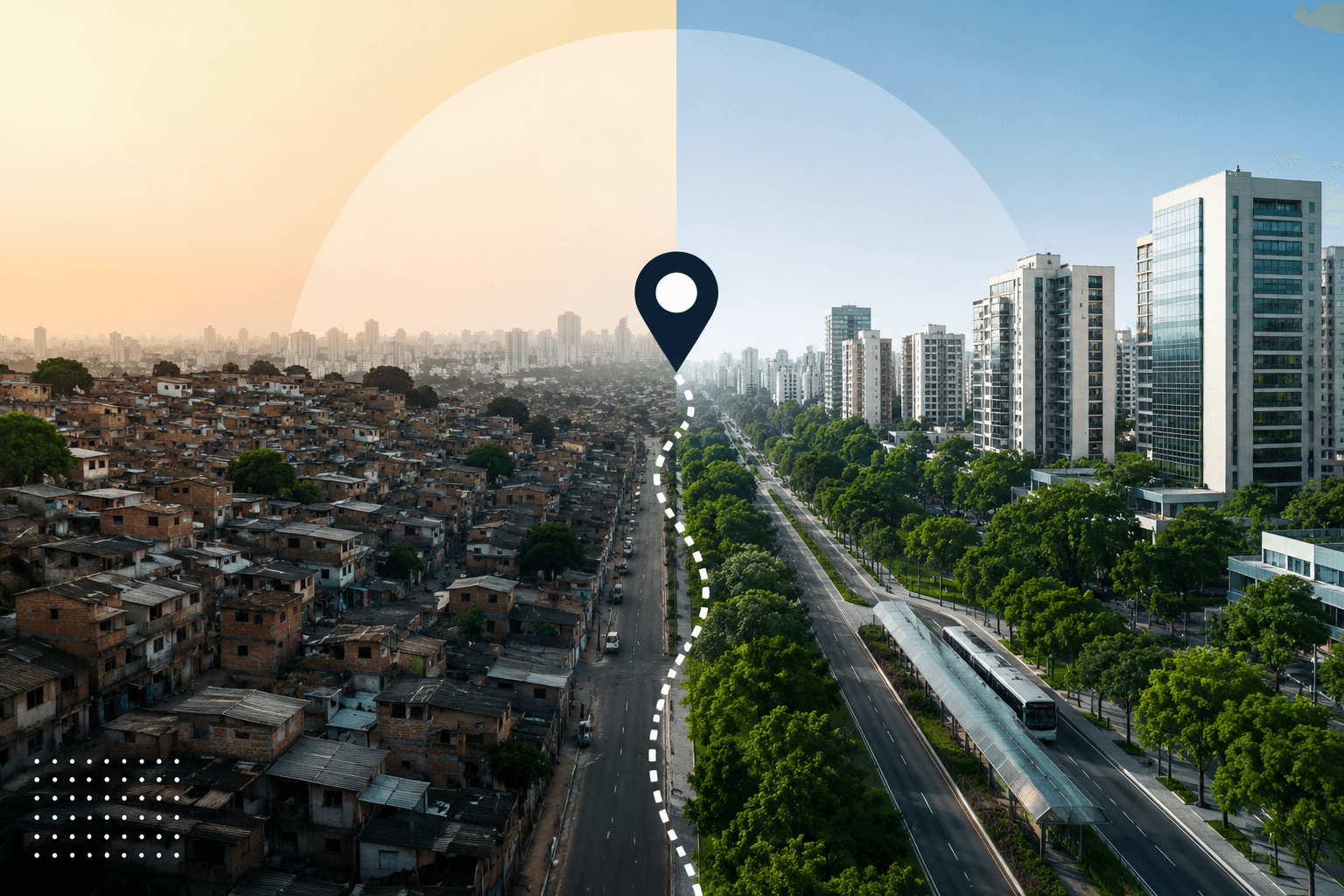
Welcome to the first post on this blog.
This space was created to explore cities, territories, spatial analysis, urban data science, and the growing role of geospatial technologies in understanding how our world works. In the coming months, we will discuss topics such as GIS, accessibility analysis, urban networks, open spatial data, remote sensing, artificial intelligence, and territorial intelligence.
Before diving into tools and methodologies, however, it is important to begin with a fundamental question:
Why do geospatial data matter?
The answer is both simple and profound: because everything happens somewhere.
Every person, building, road, business, school, hospital, and park occupies a location. Every social, economic, and environmental process unfolds within space. Understanding where things happen is often the first step toward understanding why they happen.
Beyond Numbers and Spreadsheets
When people hear the word data, they often think of numbers, tables, and spreadsheets.
Yet data are much more than that. A road can be data. A building can be data. A tree, a school, a public transit route, or a neighborhood can all be represented as data.
In essence, data are representations of reality.
What makes geospatial data unique is that they include a crucial additional component: location.
A population statistic becomes more meaningful when we know where that population lives. Information about healthcare services becomes more useful when we know where facilities are located and who can access them. Economic indicators gain new significance when viewed within their geographic context.
Location transforms information into something richer and more revealing.
Why Location Changes Everything
The same phenomenon can have completely different implications depending on where it occurs.
Consider two schools with similar infrastructure, teachers, and resources. One is located near public transportation, connected to major streets, and easily accessible to thousands of students. The other is situated in a more isolated area, far from transit options and difficult to reach.
The schools may be nearly identical on paper, but their territorial contexts are very different.
The difference lies not in the schools themselves, but in their relationship with the surrounding urban environment.
This principle applies to virtually every aspect of urban life. Hospitals, parks, jobs, businesses, and public services all derive part of their value from their location and accessibility.
Space is not merely a backdrop for social and economic activities, it actively shapes opportunities and outcomes.
Seeing What Traditional Data Cannot Show
One of the greatest strengths of geospatial data is their ability to reveal patterns that are difficult to detect through traditional statistical analysis alone.
A spreadsheet might tell us that a city has areas of poverty, but a map can show where those areas are concentrated.
A table may indicate the number of healthcare facilities, but spatial analysis can reveal which populations remain underserved.
A dataset may contain temperature measurements, but geographic visualization can uncover urban heat islands and identify neighborhoods most vulnerable to extreme heat.
When information is connected to location, previously invisible structures begin to emerge.
Patterns of segregation, inequality, accessibility, vulnerability, concentration, and connectivity become easier to identify and understand.
The territory often tells stories that numbers alone cannot.
From Objects to Relationships
Geospatial analysis is not only about locating objects on a map.
More importantly, it is about understanding relationships.
A school is important, but so is its distance from residential areas. A hospital matters, but accessibility may matter even more. A park contributes to urban quality of life, but its benefits depend on who can reach it.
This perspective shifts our attention from isolated elements to the connections between them.
Questions such as What is nearby?, What is connected?, Who has access?, and Who is excluded? become central.
Through this lens, cities can be understood not simply as collections of buildings and infrastructure, but as networks of relationships that influence everyday life.
Cities as Interconnected Systems
Urban phenomena rarely occur in isolation.
Transportation affects access to employment. Employment influences income. Income shapes housing opportunities. Housing conditions affect health outcomes and educational opportunities.
Each element is connected to many others.
This interconnected nature of cities means that understanding one urban issue often requires understanding several others simultaneously.
Geospatial data provide a framework for studying these relationships because they allow us to examine how different systems overlap and interact across space.
The city becomes visible not merely as a collection of places, but as a dynamic and interconnected system.
From Data to Territorial Intelligence
Data alone do not generate knowledge.
A dataset is simply a collection of information. To become meaningful, it must be organized, analyzed, interpreted, and connected to real-world questions.
This process transforms data into what is often called territorial intelligence.
Territorial intelligence is the capacity to use evidence to better understand places and support more informed decision-making.
It helps answer questions such as:
Where should new public investments be directed?
Which communities have the greatest unmet needs?
Where are environmental risks concentrated?
Which populations face the greatest accessibility barriers?
How can urban services be distributed more equitably?
The objective is not merely to produce maps or visualizations.
The objective is to generate knowledge that contributes to better decisions and more effective interventions.
The Growing Importance of Geospatial Data
We live in an era where enormous amounts of spatial information are generated every day.
Satellites continuously monitor the Earth's surface. Smartphones record movement patterns. Sensors collect environmental data in real time. Open-data initiatives provide unprecedented access to information about transportation networks, buildings, demographics, and land use.
As a result, geospatial data have become increasingly important across a wide range of fields, including urban planning, transportation, public health, environmental management, logistics, business intelligence, and scientific research.
The challenge today is no longer obtaining data.
The challenge is understanding what those data mean and how they can be transformed into useful knowledge.
Looking Ahead
This blog will explore the methods, technologies, and ideas that help us make sense of spatial information.
We will discuss GIS, spatial statistics, urban networks, accessibility analysis, open-source geospatial tools, territorial intelligence, and emerging technologies that are reshaping the way we study cities and regions.
Yet all of these topics share a common foundation.
Geospatial data are not simply about maps.
They are about understanding relationships, revealing hidden patterns, identifying inequalities, and making better decisions about the places where people live, work, and interact.
Because every phenomenon happens somewhere.
And every place has a story waiting to be understood.